
Many of us get fascinated with the woodwind of South India – Carnatic flute also referred to as Pullankuzhal or Venu. The instrument finds its place in the vedic period right from Lord Krishna playing the flute in the brindavan gardens. Even though the instrument has its mention right from the vedic age and formal roots of carnatic music dates back to early 12th century, the carnatic flute, which is used in Southern part of India was was bought to main stream as carnatic flute only the beginning of 20th century by Sharaba Shastri (1872-1904).
The carnatic flute instrument was brought into mainstream carnatic live concerts by Palladam Sanjeeva Rao, disciple of Sarabha Shastri and only then it was recognised as one of the carnatic music instruments. However TR Mahalingam (affectionately known as Mali) made the instrument very popular among the carnatic music fraternity and from there onwards carnatic flute became one of the main instruments in carnatic music.
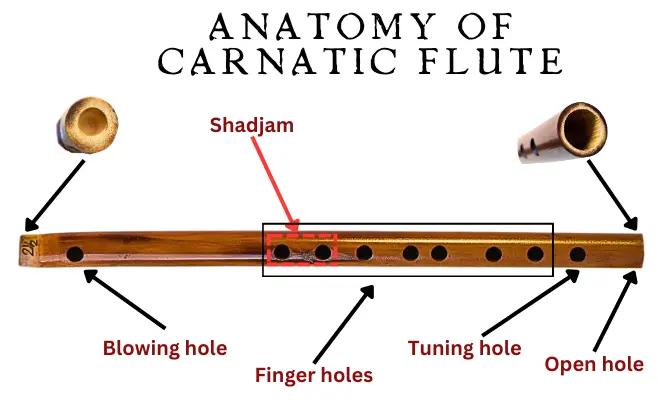
Anatomy of Carnatic Flute
An authentic carnatic flute is made from specific varieties of bamboo found in forests in Karnataka & Kerala. The flute has eight finger holes and one blowing hole. It also has a natural node near the blowing holes. You can find cheap flutes with cork in one end or flutes made in plastic, glass etc. they are not considered as authentic carnatic flutes.
Understanding the Different Types of Carnatic Flutes
Before we get deep into different types of carnatic flute, it is essential to understand a little bit of theory. In music there is something called Scales. Each scale has 12 notes – A, A#, B, C, C#, D, D#, E, F, F#, G, G# (B & E do not have sharp notes, it may be a heavy dose of theory if we get into it, we will reserve it right now to keep the discussion simple).
Another concept you have to understand is Octave – Each octave has 12 notes, and it keeps repeating in cycles. If you take a 61 keys keyboard, it has 5 octaves, if you take one string in an electric guitar, you can play 12 notes. This is basically because of the design of those respective instruments. Similarly in carnatic flute each flute can be used to play a particular scale only (advanced carnatic flute players can transpose and play). So for 12 notes in a scale, you will need 12 flutes, one for each note.
Bass Carnatic flutes are not popular amongst Carnatic flute players although flute vidhwan Shashank uses them in majority of his live performances. However contemporary players like TR Mali, Dr. N Ramani, Sikkhil Sisters use mid octave flutes. These flutes are melodious and sweet when you hear. The challenge with bigger size flutes is the space between finger holes will be large and therefore it will become difficult to play at a beginner level.
Apart from the mid octave flute set (12 flutes, one for each scale), at best you can play 5 flutes in lower octave flute set (B, A#, A, G# & G). Even G becomes very difficult to play and any flute beyond G is almost impossible to play because the size becomes too large to play.
So in a nutshell the entire carnatic flute set if one has to buy is around 17 flutes (12 in mid-octave & 5 in lower-octave).
Key Features to Consider When Buying a Carnatic Flute
The following are the three specific features in the anatomy of authentic carnatic flute
- Made from bamboo
- The flute has to be perfectly tuned. (The Shadajam or the root note comes when you blow covering the first two finger holes. Similarly the other notes.) You should also check if you are able to play higher notes comfortably. 90% of the carnatic flutes you find in the market will fail this test.
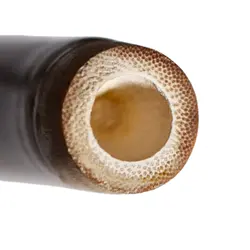
- The hole near the blowing hole has a natural node (referred to as ‘Kanu’)
- Size of the flute. (We will discuss this separately)
How to Choose the Right Size for Your Carnatic Flute
Each scale of the flute comes in different sizes and if you are new to the world of carnatic flutes it will be daunting to buy your first carnatic flute. The two important features that you have to consider while buying your first carnatic flute are given in the following paragraphs:
1.Space between finger holes
You should move the fingers comfortably between the finger holes, if it is long then you will find it difficult as a beginner player. So given below are the agewise recommended flutes as a beginner.
| Age Group (yrs) | Primary Note | Secondary Note |
| 7 – 8 | G or G# | None |
| 8 – 10 | F or F# | None |
| 10 – 15 | F | E |
| >15 | D# | E |
2.Finger Hole Size
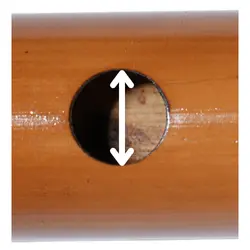
Many of us may have thinner fingers, however the carnatic flutes that you find in the market are made in one size and it may be a challenge to cover the full hole with thin fingers and the air will escape from the uncovered parts of holes while playing and therefore you will not be able to get the perfect notes and the melody will not be right, despite you playing perfect.
So for these customers we strongly recommend customised carnatic flutes with smaller finger hole sizes.
Tips for Testing a Carnatic Flute Before Purchase
It is important that you test the carnatic flute before purchase or you may want to make sure the flute is tested by a professional flautist before you buy. Once you have decided the scale of the key, check if you are able to get all the 7 notes (Sa, Ri, Ga, Ma, Pa, Da, Ni, Sa) perfectly using any instrument tuner. (You can download the Instrument Tuner App).
Given below is a ready reckoner of 7 notes of each scale. Also in the world of carnatic music scale is called Shruti or Kattai.
Scale/Shruti/Kattai | Sa | Ri | Ga | Ma | Pa | Da | Ni |
| 1 | C | D | E | F | G | A | B |
| 1.5 | C# | D# | F | F# | G# | A# | C |
| 2 | D | E | F# | G | A | B | C# |
| 2.5 | D# | F | G | G# | A# | C | D |
| 3 | E | F# | G# | A | B | C# | D# |
| 4 | F | G | A | A# | C | D | E |
| 4.5 | F# | G# | A# | B | C# | D# | F |
| 5 | G | A | B | C | D | E | F# |
| 5.5 | G# | A# | C | C# | D# | F | G |
| 6 | A | B | C# | D | E | F# | G# |
| 6.5 | A# | C | D | D# | F | G | A |
| 7 | B | C# | D# | E | F# | G# | A# |
If you are able to get the 7 notes perfectly then you can ask them to play higher Pa & Ma. (This might be little difficult for a beginner carnatic players)
Buy Carnatic Flute Online
Maintenance and Care for Your Carnatic Flute
After playing, use a soft cloth and wipe both inside and outside of the flute. You can use a rod, cover it with soft cloth and use it to clean the interior part of the flute. Keep them under normal room conditions, If you are living in locations where the temperatures are very low, you may want to keep the flute stored at a relatively warm temperature.
Since the carnatic flute is made of wood generally they can generally withstand low temperatures as low 15* C. However if the temperature drops lower than that, since the flutes are made of wood they can absorb moisture and the tuning can get affected. Then you may want to keep in a plastic pipe or any other cover that can cut moisture.
The Importance of Material in Flute Selection
Where to Buy Your Carnatic Flute: Online vs. Local Stores
You can buy carnatic flutes either online or in local stores as long as they meet the required parameters in terms of tuning and other key features. We sell perfectly tuned carnatic flutes, and you may want to explore our Carnatic Flute Catalogue for more details.
Conclusion: Finding Your Perfect Carnatic Flute
Many carnatic flutes that you find in markets are mass produced and you will find more than 90% of carnatic flutes fail the tuning check. So it is advised that you do good research before buying your first carnatic flute.